VFR wind calculator: drift, heading and crosswind
See how wind changes a ground path, and separate a wind into headwind and crosswind components.
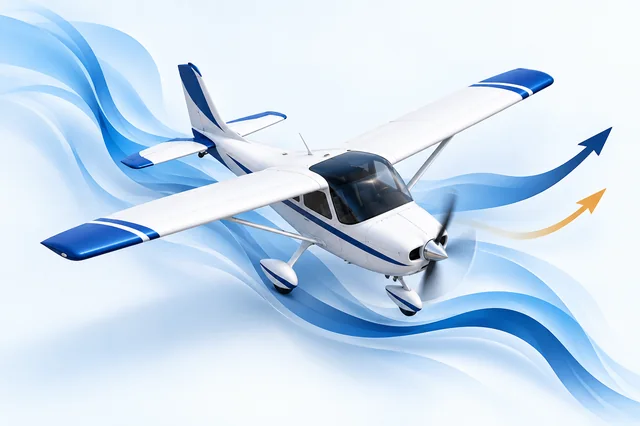
Learn with a fictional example
Learn with a fictional example
For education only. These fictional cases are not a flight briefing, navigation instruction or aircraft loading approval. Use current official information and approved aircraft documentation for real operations.
Static walkthrough: no fields or settings are changed.
Steps
Explore how wind changes the relationship between course, heading and speed. Select the wind-triangle mode, check the speed unit and keep all directions relative to true north.
Worked example
Fictional exercise: course 090°, true airspeed 100 kt, wind from 090° at 20 kt. The engine gives heading 090°, correction 0° and ground speed 80 kt.
Read the result
Ground speed is speed over the ground; true airspeed is speed through the air. Here the headwind reduces ground speed by 20 kt. A variable or excessive crosswind can prevent a unique solution. This is a steady-wind model, not a flight recommendation.
Share this tool
Only the tool’s public link is shared. Your inputs and results stay here.
Show link to copy manually
Quick answer
Find the mathematical heading correction that balances sideways wind along a chosen ground path.
The page and its assets load from the site; this operation uses your entered values only in this browser and does not send them to a calculation endpoint.
How to use it
See how wind changes a ground path, and separate a wind into headwind and crosswind components.
Limits
The output reflects the method and inputs described here. Check it before relying on it for an important decision.
Frequently asked questions
Are drift and wind correction the same angle?
No. Wind correction is the heading offset from the desired track that cancels sideways wind in this model. Positive is right; negative is left. This is not uncorrected drift. Uncorrected drift is actual track minus held heading, expressed as a signed angle from −180° to less than +180°. Positive is drift right; negative is drift left. It differs from the correction angle.
Which north reference should I use?
Use the same north reference for every angle: desired track, heading, runway bearing and wind direction. No automatic true–magnetic conversion is applied. METAR wind uses true north. Runway bearings may be magnetic: do not mix the references.
Can I use a variable wind direction?
A nonzero wind with variable or unknown direction has no single exact component, correction or track result. Enter a known direction to calculate one scenario.
Does this decide whether a flight is safe?
Learning model only: constant horizontal wind and fixed true airspeed. Not a flight briefing or an operational recommendation; no aircraft limits or live weather are assessed.
Sources and references
- FAA — Pilot’s Handbook of Aeronautical Knowledge: Navigation
- FAA — Pilot’s Handbook of Aeronautical Knowledge: handbook index
- FAA crosswind component geometry: equation 2
These references document the cited standard or browser API; they do not validate the tool’s output.