Mass and balance: learning calculator
Explore how loading and fuel use change mass and centre of gravity (CG). Enter your own data or open the clearly fictional exercise.
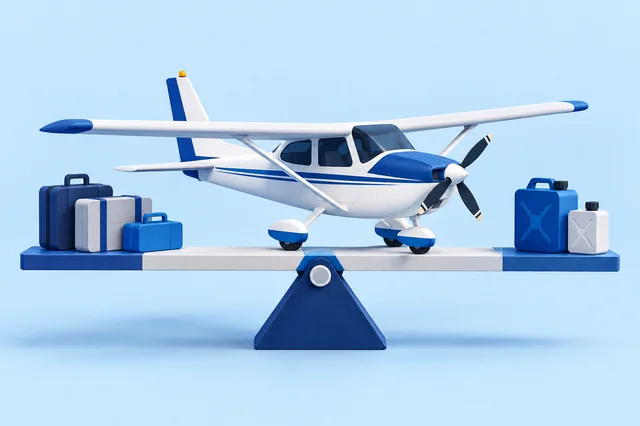
Learn with a fictional example
Learn with a fictional example
For education only. These fictional cases are not a flight briefing, navigation instruction or aircraft loading approval. Use current official information and approved aircraft documentation for real operations.
Static walkthrough: no fields or settings are changed.
Steps
Explore mass, moment and centre of gravity using the bundled fictional profile. Review its datum, units, loads, limits and fuel burn before using its calculation controls. Never substitute this profile for a real aircraft.
Worked example
Bundled exercise: empty mass 500 kg at 1 m; payload 150 kg at 1.2 m; fuel 80 kg at 1.1 m. Initial mass: 730 kg. Moment: 768 kg·m. Centre of gravity: 768 ÷ 730 ≈ 1.052 m from the fictional datum.
Read the result
After 5 kg taxi burn the model gives 725 kg; after a further 35 kg trip burn, 690 kg. A result within supplied limits checks only those fictional limits. It does not verify the aircraft data or approve loading. Changing units must not change the physical result.
Reference: FAA Weight & Balance Handbook
Share this tool
Only the tool’s public link is shared. Your inputs and results stay here.
Show link to copy manually
Quick answer
Each moment = mass × signed arm. Total mass includes empty mass; total moment includes the empty-mass moment. CG = sum of moments ÷ sum of masses. Moments use the selected mass unit × arm unit. Compare limits before rounding. The CG path is evaluated within the stated fuel-use model, not just at its endpoints.
The page and its assets load from the site; this operation uses your entered values only in this browser and does not send them to a calculation endpoint.
How to use it
Explore how loading and fuel use change mass and centre of gravity (CG). Enter your own data or open the clearly fictional exercise.
Limits
The output reflects the method and inputs described here. Check it before relying on it for an important decision.
Frequently asked questions
Does a result approve my aircraft for flight?
For learning only. A result within the supplied limits does not establish fitness for flight. This tool does not verify aircraft documents, actual loading, performance or every applicable limitation. Real aircraft data that have not been verified are outside this evaluation.
Are real aircraft profiles included?
No real aircraft catalogue: validated source documents are not yet available. Supply your own profile data; the only prefilled option is fictional.
How is fuel consumption modelled?
Enter initial fuel mass and taxi/trip burn separately for each tank, in the selected mass unit, not litres or gallons. Each tank has a fixed arm. During each phase, all tanks burn simultaneously in proportion to their entered consumption for that phase. Burn must not exceed the fuel remaining. Check what fuel is already included in empty mass to avoid double-counting.
How is the centre of gravity calculated?
Each moment = mass × signed arm. Total mass includes empty mass; total moment includes the empty-mass moment. CG = sum of moments ÷ sum of masses. Moments use the selected mass unit × arm unit. Compare limits before rounding. The CG path is evaluated within the stated fuel-use model, not just at its endpoints.
Sources and references
These references document the cited standard or browser API; they do not validate the tool’s output.